
Introducing FORGE
A generative model for novel lipid design, grounded in reaction chemistry
An RNA sequence can contain the instructions for a useful protein and still never reach the inside of a cell. Lipid nanoparticles help carry those instructions into cells, and the structures of their constituent lipids shape how well they do it.
Standard approaches to ionizable lipid discovery synthesize and screen libraries built from predefined reactants. The assembly chemistry is known, but the search is limited to combinations of the selected building blocks. Many reaction-based generative methods retain that constraint by choosing reactants from a supplied catalogue. Whole-molecule models allow a broader structural search, but leave the question of assembly to a separate check.
We developed FORGE to use known reaction chemistry without restricting generation to a fixed reactant catalogue. Rather than choosing the building blocks in advance, we specify their roles and the reactions that join them. FORGE generates the complete lipid structure, then recovers candidate precursors and checks that the specified chemistry reconstructs the proposed molecule. This allows it to propose new precursor structures while testing the resulting assembly.
 View full-size figure
Generation and route assessment. A reaction program fixes assembly roles while leaving precursor identities open. FORGE generates the molecular graph, checks exact assembly replay, and traces the implied precursors to evidence-qualified materials or an explicit abstention. These are computational checks, not experimental synthesis evidence.
Figure 1 in the FORGE paperA different design space
Generating a new combination of familiar reactants and generating a new precursor are different kinds of exploration. FORGE learns to propose the product graph without selecting its components from a fixed inventory. A successful proposal must still admit precursors whose registered reaction reconstructs that graph.
The released model studies this problem across Ugi three-component reactions, repeated aza-Michael addition, and repeated reductive amination. These provide three settings in which to measure both exact assembly and exploration beyond the training catalogue. [1]
One molecular design, two representations
Structure study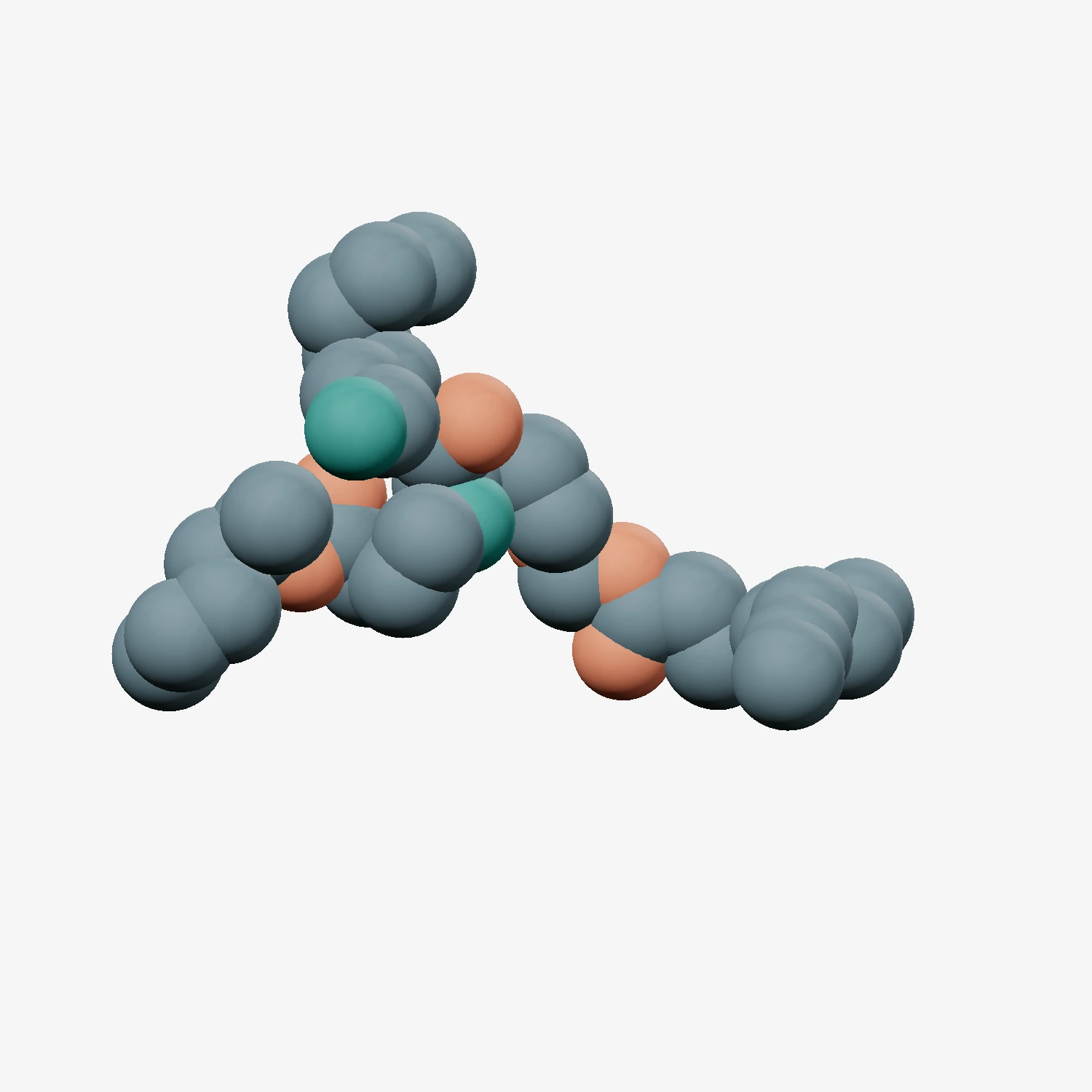
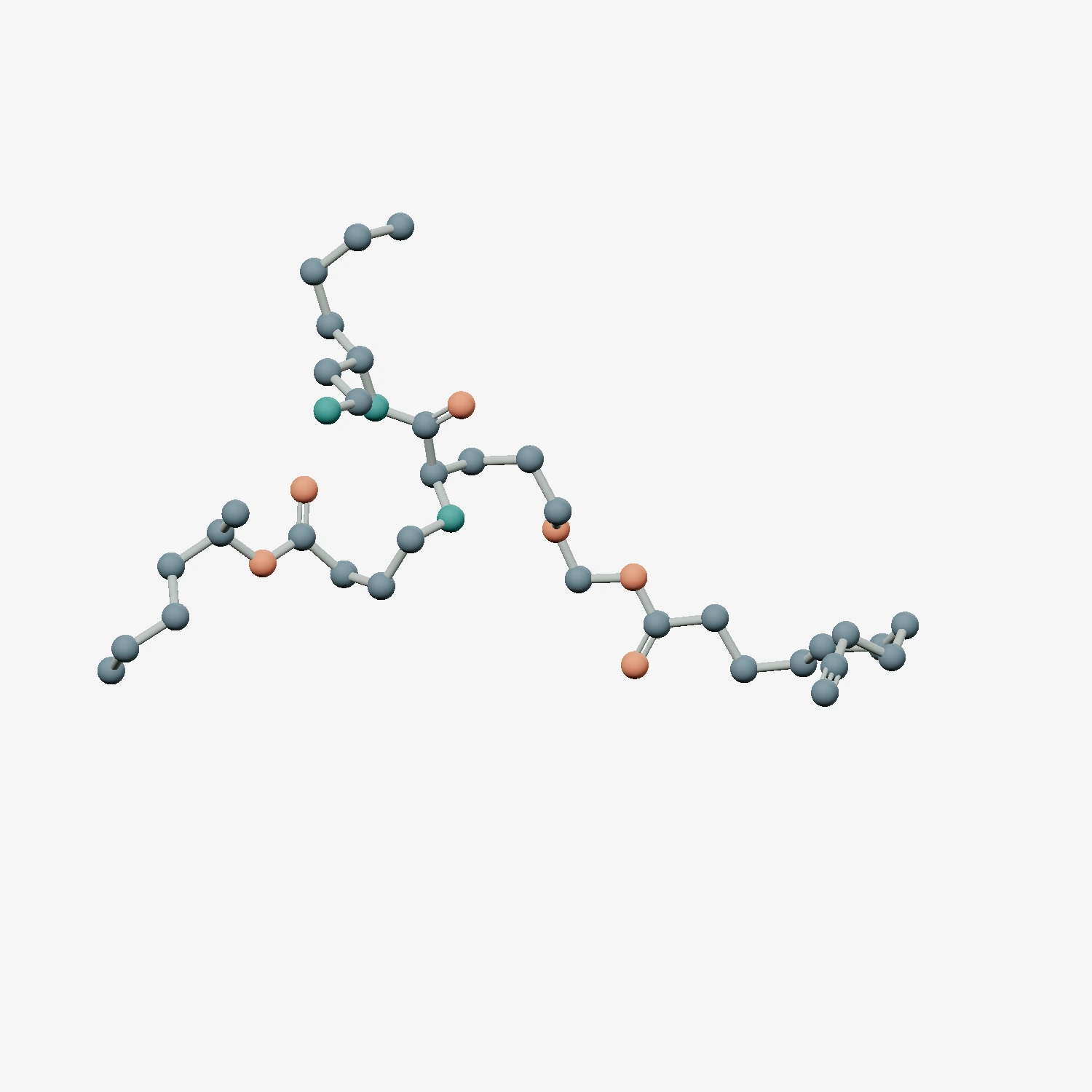
FORGE-Ugi-2713 from the manuscript’s display atlas. Space-filling atoms show the molecule’s shape; the bond view reveals connectivity. Both depict one computed ETKDGv3/MMFF94s conformer with hydrogens omitted. The conformation and unspecified stereochemistry are illustrative, and the two views are fitted separately.
FORGE-Ugi-2713 · download conformer ↗Generated molecular structures
One assembly. Different designs.
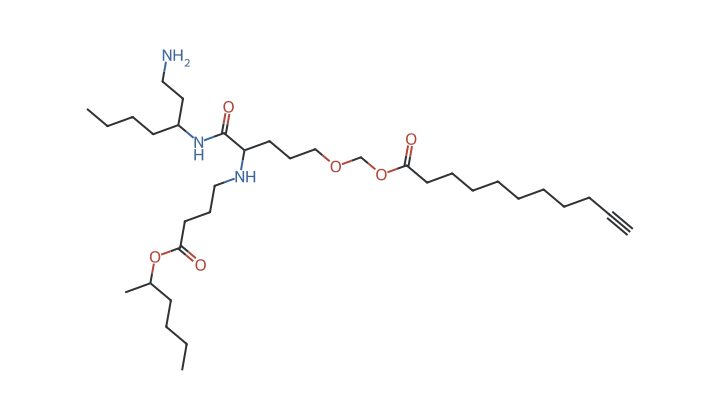
FORGE-Ugi-2713
43 heavy atoms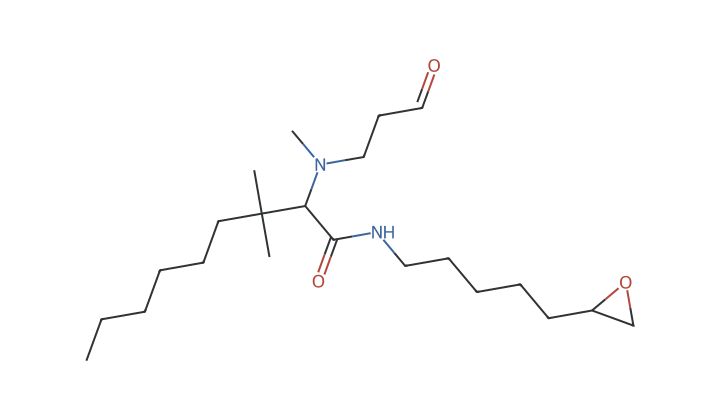
FORGE-Ugi-1763
27 heavy atoms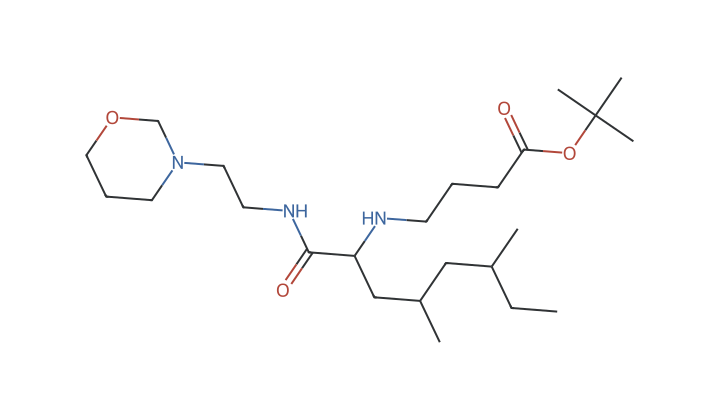
FORGE-Ugi-1403
31 heavy atoms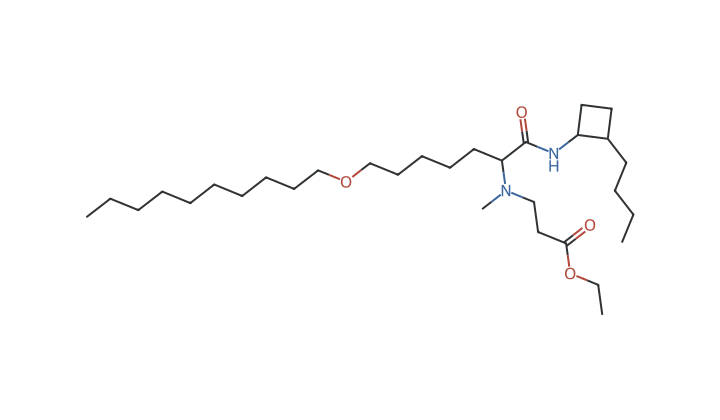
FORGE-Ugi-2480
37 heavy atomsThis is a contribution to molecular design and delivery-system research. Applying the same idea to other molecular classes requires suitable reaction representations, training data, and evaluation; the lipid release does not establish that transfer by itself.
Condition on the assembly, not a list of parts
The input is a reaction program. It describes the assembly chemistry, precursor roles, positions involved in the reaction core, transformation order, and coarse molecular architecture. Those constraints tell the model something about how a product is organized without supplying the identities of all its precursors.
The distinction is consequential. A role can specify where a precursor contributes to the product while leaving its exterior structure open. The model can therefore propose structures that are not obtained simply by selecting a different combination from a fixed reactant list.
That flexibility also makes the conditioning contract important. A generated molecule may admit an exact assembly yet differ from the requested architecture. Assembly consistency and adherence to the requested program answer different questions and should be evaluated separately.
Generate atoms, bonds, and topology together
FORGE uses a conditional discrete flow over a molecular representation. The state includes atom identities, bond identities, and connectivity. A spanning-tree representation describes the connected structure, with additional edges representing ring closures.
During training, the model learns to predict clean molecular states from intermediate categorical states together with the reaction program. During sampling, those predictions guide transitions toward a complete graph. Program-fixed coordinates stay fixed; the remaining coordinates can change.
The time coordinate describes progress through generation. It is not physical reaction time, and the intermediate categorical states should not be read as chemical intermediates. A final decoded structure still needs structural and chemical checks.
This separation makes the output easier to assess. A model can generate a plausible-looking graph without passing assembly replay, and an assembly-consistent graph can still have undesirable molecular properties. No single score replaces these checks.
Recover the precursors. Rebuild the product.
After generation, reverse decomposition searches for precursor structures and an assembly trace under the registered chemistry. Each candidate explanation is tested by applying the forward transformation again.
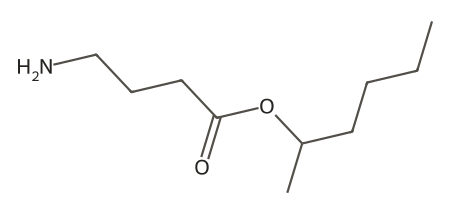
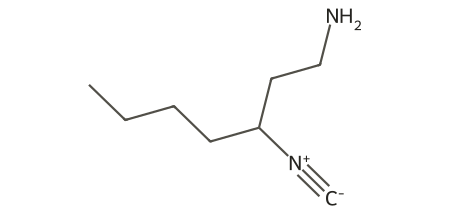
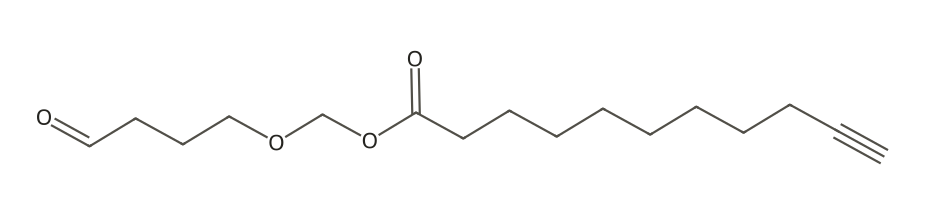
Recovered precursors corresponding to the generated product shown above. Forward replay checks whether the registered assembly reconstructs that product. These molecular drawings do not establish precursor preparation or experimental synthesis.
The comparison concerns molecular constitution: atom labels, bond connectivity, bond orders, and formal charges. It should not be interpreted as a stereochemical, kinetic, or yield prediction.
Forward replay is stronger than recognizing a reaction-like substructure in the output. It asks whether the recovered inputs actually reconstruct the product under the specified transformation. The released inference workflow retains the attempted outputs and their assembly records, including rejected attempts. [2]
Two qualifications matter. A bounded reverse search can miss a valid explanation. And finding one recovered precursor absent from a training catalogue does not prove that every possible assembly uses a novel precursor. Search coverage, exact reconstruction, and component novelty require separate accounting.
Three questions behind “can we make it?”
Exact final assembly is the first layer of synthesis evidence. A complete preparation plan also has to account for the precursors themselves and the materials at the ends of their routes. The three layers below make those dependencies explicit.
- L1Final assembly
Do the recovered precursors reconstruct the generated product?
Exact constitutional agreement under the registered transformation.
- L2Precursor preparation
How could the specific precursor structures be made?
Evidence for preparation routes, including unresolved steps.
- L3Terminal materials
Are the materials at the ends of those routes available?
Recorded material identities and procurement evidence.
A molecule can pass L1 and still have unresolved precursor preparation at L2. A proposed preparation route may rely on a material whose procurement evidence is incomplete at L3. Those outcomes carry useful information: they identify what must be resolved before a design is ready for experimental work.
Evaluation should retain the denominator of requested designs and report failed or unresolved cases. Reporting only the structures that survive every filter can conceal how much search was required to find them.
How we evaluated FORGE
The three-reaction study asks three related questions: can one model produce exact assemblies across different reaction programs, does conditioning help under a fixed sampling budget, and can the resulting products contain precursor structures absent from training?
The primary comparison trains three matched arms: the correctly conditioned model, a shared model without program information, and a model with cyclically incorrect reaction identities. Architecture, optimization budget, generation-attempt count, and final-checkpoint selection are matched. Component-disjoint held-out products are excluded from both training and checkpoint selection.
Each reaction is evaluated on 3,072 generation attempts for each of three independent training seeds. The headline metric, verified exact-L1 yield, divides the number of outputs passing molecular validation, decomposition, and exact forward replay by all generation attempts. A rejected proposal therefore remains in the denominator. Across the correctly conditioned runs, this accounts for 27,648 attempts. [3]
The paper reports means and sample standard deviations across the three training seeds. These describe variation from retraining. They are not confidence intervals, and thousands of samples from one checkpoint are not thousands of independent training replicates.
Assembly information changes generation
FORGE achieves 96.4% exact-L1 yield on Ugi, 72.2% on repeated aza-Michael addition, and 52.3% on repeated reductive amination. Removing program information lowers those means to 34.8%, 19.2%, and 37.0%, respectively.
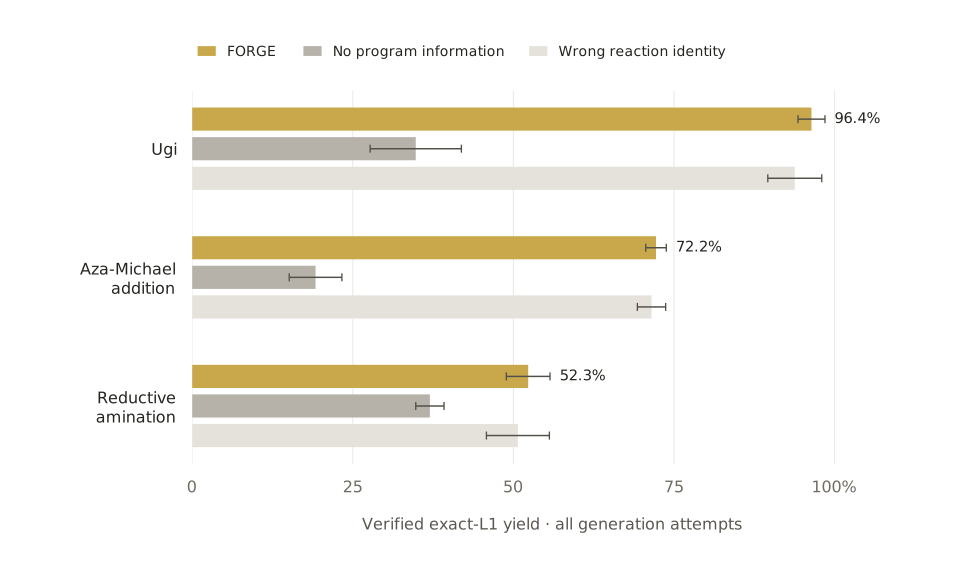
| Reaction program | FORGE | No program | Wrong identity |
|---|---|---|---|
| Ugi | 96.4 ± 2.1 | 34.8 ± 7.1 | 93.8 ± 4.2 |
| Aza-Michael addition | 72.2 ± 1.6 | 19.2 ± 4.1 | 71.5 ± 2.2 |
| Reductive amination | 52.3 ± 3.4 | 37.0 ± 2.2 | 50.7 ± 4.9 |
For Ugi, correct conditioning improves the mean by 61.6 percentage points over the no-program arm. The corresponding differences are 53.0 points for aza-Michael addition and 15.4 points for reductive amination. The benefit concerns assembly-consistent yield under a matched attempt budget; it is not a measurement of experimental synthesis or biological performance.
The cyclic control gives a more specific answer. It changes the reaction-identity label while retaining precursor roles, core coordinates, and depth. Its yields remain relatively close to the correctly conditioned arm. The study therefore supports the value of the structured reaction program, but does not establish a large independent effect from the identity label alone.
No fixed-coordinate violation or support overflow was recorded across the 27,648 conditioned attempts. That is an implementation check. Similarly, every verifier-returned trace replays exactly because exact replay defines admission to that set; the nontrivial outcome is how frequently generation produces a molecule with such a witness.
Consistency and exploration in a common Ugi benchmark
A separate comparison puts FORGE alongside reaction-space, whole-molecule, and finite-inventory methods under a common component-disjoint Ugi protocol. Each method is evaluated with the same attempt accounting and exact-L1 evaluator. The table reports products per 1,000 attempts, not percentages.
| Method | Exact L1 ↑ | Distinct component-novel ↑ | Held-component recovery ↑ |
|---|---|---|---|
| FORGE | 963.9 ± 21.4 | 862.6 ± 19.2 | 1.4 ± 1.7 |
| DeFoG (unconditional) | 280.6 ± 26.6 | 280.6 ± 26.6 | 15.5 ± 2.4 |
| GenMol / SAFE | 0.0 ± 0.0 | 0.0 ± 0.0 | 0.0 ± 0.0 |
| RGFN | 0.0 ± 0.0 | 0.0 ± 0.0 | 0.0 ± 0.0 |
| Learned inventory selector | 1000.0 ± 0.0 | 0.0 ± 0.0 | 0.0 ± 0.0 |
| Finite catalogue oracle | 1000.0 ± 0.0 | 0.0 ± 0.0 | 0.0 ± 0.0 |
| Shared-null + post-hoc | 114.4 ± 10.9 | 108.5 ± 9.7 | 0.4 ± 0.2 |
| FACT-matched | 52.0 ± 15.6 | 50.8 ± 14.4 | 0.0 ± 0.0 |
| FACT-generous | 296.7 ± 186.0 | 288.3 ± 175.3 | 0.1 ± 0.2 |
The inventory methods reach 1,000 exact assemblies per 1,000 attempts. That is a useful strength of assembling accepted components with a specified reaction. Their component-novel yield is zero by construction, because the components come from the supplied inventory.
FORGE produces 963.9 verified products and 862.6 distinct component-novel products per 1,000 attempts. In this comparison it combines a high assembly yield with recovered components outside the method-visible training catalogue. DeFoG produces 280.6 verified products per 1,000 attempts, while GenMol/SAFE produces no exact Ugi-L1 product and RGFN emits no admissible output under this setup.
The comparison also exposes a limitation: DeFoG recovers reserved held-out components more frequently than FORGE, at 15.5 versus 1.4 products per 1,000 attempts. Producing a precursor absent from the training catalogue and recovering a particular held-out precursor are different forms of generalization.
These results are specific to the common Ugi setup. They are not a universal ranking of the methods. The paper also finds structural distribution differences between generated molecules and excluded observed-lipid references for every method; reaction consistency alone does not establish realism or biological utility.
Which parts of the architecture help?
The mechanism study compares joint whole-molecule denoising with independent precursor-role generation under a parameter-matched FACT model. Its full Transformer is trained separately from the production model, so its numerical results should be read as an ablation study.
| Reaction | Joint Transformer | FACT-matched |
|---|---|---|
| Ugi | 856.9 | 56.9 |
| Aza-Michael addition | 767.7 | 396.4 |
| Reductive amination | 318.8 | 520.3 |
Joint denoising produces more exact-L1 products for Ugi and aza-Michael addition. Reductive amination favors the factorized model. The result suggests that the benefit of coordinating precursor roles depends on the reaction family and available supervision.
Other interventions reinforce that conclusion. Removing cross-attention reduces Ugi and reductive-amination yield but increases aza-Michael yield. Removing gradient-conflict control slightly improves all three reported means. The paper does not support claiming that every architectural module independently improves every reaction.
A separate fixed-weight decoder check finds that enforcing Ugi reaction-core hydrogen states increases exact-L1 yield with nearly unchanged molecular validity. Changing the decoder changes the generated graph; it is distinct from applying a more permissive acceptance test.
Exploratory reporter-expression measurements
The manuscript also describes three lipids from the shared three-family model that were synthesized and formulated with firefly luciferase mRNA. The recorded four-hour imaging signals are shown below alongside a DLIN-MC3-DMA formulation.
| Formulation | Reported value |
|---|---|
| FORGE-1 | 5.997 × 10⁵ |
| FORGE-2 | 2.036 × 10⁶ |
| FORGE-3 | 2.881 × 10⁶ |
| DLIN-MC3-DMA | 2.195 × 10⁵ |
All three recorded FORGE values exceed the recorded DLIN-MC3-DMA value. These observations support reporter expression in that exploratory experiment. They do not establish a statistically supported delivery advantage: the record contains one reported value per formulation, with the signal-unit and replicate information needed for a quantitative comparison unresolved.
The experimental designs are designated FORGE-1, FORGE-2, and FORGE-3 in the manuscript. They are distinct from the illustrative FORGE-Ugi-2713 structure shown at the start of this article. Computational assembly results and these experimental observations should be read as separate evidence.
From a molecular proposal to an experimental question
FORGE gives us a way to connect molecular proposals with inspectable assembly evidence. Experimental work must then establish what the computational checks cannot: whether a specific preparation succeeds, what product is obtained, and how that material performs.
For delivery systems, the molecule is one part of a larger system. Formulation, cargo, dose, and biological context also influence performance. Assembly consistency alone does not establish delivery activity.
At Kosha, this fits into a wider research loop: generate candidates, inspect their chemistry, test selected designs, and use the measurements to inform subsequent design decisions. COMPOSE addresses a complementary part of that loop by constructing and selecting molecular edits under explicit task constraints.