
Introducing COMPOSE
A state-of-the-art generative model for small-molecule design and optimization
Finding a molecule that binds a target is often the beginning of a design problem. The next molecule may need to dissolve more readily without losing that interaction. As experiments reveal what works and what fails, the requirements change again.
For a generative model, this raises a question about what is worth learning once. A model trained to produce molecules for one objective may be difficult to reuse when the objective changes. Yet many of the underlying operations—extending a fragment, modifying a ring, reconnecting parts of a structure—remain useful across those tasks.
COMPOSE learns a process for changing molecules, which a separate controller steers toward the current goal. The same learned process supports fragment design, constrained editing, and optimization without retraining for each objective. The experiments ask how far this reuse can extend, and how much search it takes to find candidates that meet each task’s requirements.
 View full-size figure
A reusable process of molecular change. An executor commits legal edits to complete molecular states. A fixed learned reference assigns probabilities to distinct successors, while a task-specific controller selects edits or programs using task context and feedback history.
Figure 1 in the COMPOSE paperDesign as a sequence of decisions
Changing a molecule also changes what can happen next. Adding an atom creates new attachment opportunities. Closing a ring changes which bonds can be modified. A useful molecular-design system must reason about both the immediate change and the options that remain afterward.
COMPOSE—COntrollable Molecular Process Over Stochastic Edits—separates three questions: which transformations are legal, which transformations the model prefers, and which transformations serve the current design objective. An exact rewrite executor answers the first, a learned reference process the second, and a task-specific controller the third. [1]
In the manuscript, the same GuacaMol-trained reference checkpoint supports fragment-constrained generation, similarity-constrained editing, black-box optimization, and protein-specific lead optimization. The task controller changes; the underlying reference model is not retrained or fine-tuned for each objective.
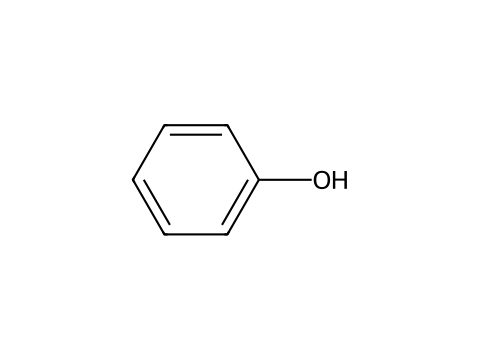
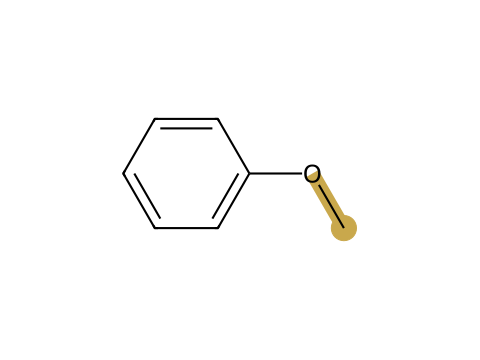
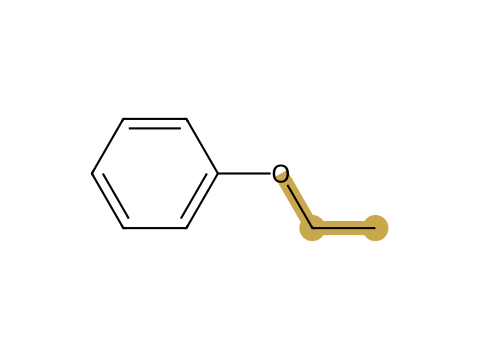
A molecule can be changed through a sequence of graph edits while retaining a common region. Gold marks the added carbons and bonds. This illustrative sequence shows atom insertion; it is not a COMPOSE sample or a synthetic reaction pathway.
Every committed state is a complete molecule
COMPOSE operates on connected molecular graphs with explicit atom, bond, and valence rules. The graph can grow or shrink along a trajectory. At each state x, the executor determines the set A(x) of edits whose results stay within that molecular representation.
The primitive vocabulary contains eight families: atom insertion, deletion, and restatement; bond reordering and rerouting; cycle closure and opening; and coordinated changes to ring aromaticity. Larger transformations combine these primitives. Every intermediate state is checked by the same executor.
A vocabulary of molecular changes
Small edits. New structures.
Atom insertion
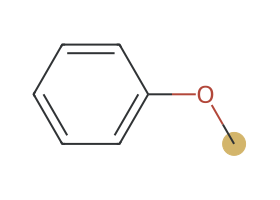
Extend a substituent with a carbon.
Atom substitution
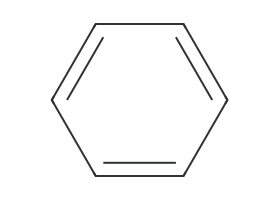
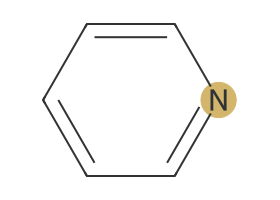
Replace a ring carbon with nitrogen.
Bond-order change
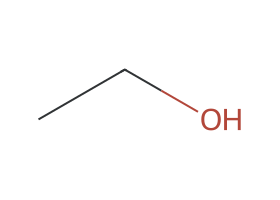
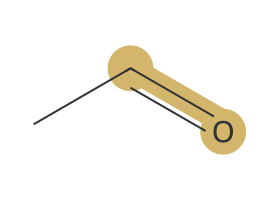
Change a single bond to a double bond.
Ring closure
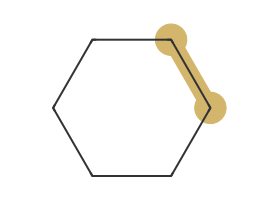
Join two atoms to close a ring.
This makes molecular validity part of execution. It does not make each edit a laboratory reaction or establish a synthetic route. A graph can satisfy the representation’s chemical rules without being easy to synthesize, stable under experimental conditions, or biologically useful.
Learn which legal transitions to prefer
The reference model assigns probabilities to legal edit families and their molecular operands. Different edit descriptions can lead to the same canonical molecule, so COMPOSE sums their probability mass before normalizing over distinct, non-self successors.
Training maximizes the probability of the realized canonical successor in executable teacher transitions. The corpus contains 1,803,032 stored training transitions, all of which passed the frozen structural gate. The learned object is a conditional transition law: a preference over where to move from a molecule, rather than an unconditional score for that molecule.
To test whether the model learned more than common edit frequencies, the paper scores 3,545 held-out transitions with training-disjoint sources. All comparison laws see the same legal successors. Only their probability assignments differ.
| Probability assignment | NLL (nats) |
|---|---|
| Uniform successors | 6.25 |
| Empirical edit-family frequencies | 5.37 |
| Learned family, uniform successor | 5.17 |
| Empirical family, learned successor | 4.10 |
| Full learned reference | 3.90 |
The full model reduces negative log-likelihood from 5.37 to 3.90 nats relative to empirical edit-family frequencies. Holding family probabilities at their empirical frequencies while learning successor identity recovers 86.7% of the reduction. Most of the improvement therefore comes from learning which molecular successor to prefer within a family.
The supervision matters to the interpretation. Ring-family training examples come from synthetic perturbations. On the 2,744 evaluated transitions from families with data-backed supervision, the full reference still improves over empirical frequencies, from 5.55 to 4.49 nats. The learned-identity-only variant reaches 4.25 nats on that subset, so the learned family gate is not uniformly beneficial. These are transition-prediction results, not measurements of reaction kinetics.
Compose local edits into larger transformations
A useful structural change may require several dependent edits. A later operation might act on a bond or atom created earlier. COMPOSE represents such a change as an executable program: an ordered sequence of primitives, each legal at the state produced by the preceding step.
Programs coordinate transformations without adding a second set of molecular rules. The controller can protect retained substructures, restrict attachment sites, choose archive molecules as parents, or decide which completed candidates deserve an expensive evaluation.
- 01Fragment generation
Protected structure, attachment rules, and endpoint selection.
Check fragment retention and chemical validity separately.
- 02QED editing
A fitted finite-horizon value head and sequential Monte Carlo.
A computed drug-likeness target with a source-similarity constraint.
- 03PMO
Executable program proposals, an archive, and objective-query allocation.
Compare outcomes under the same objective-query budget.
- 04T4 docking
Lead constraints, a program-template prior, and docking feedback.
Docking is a computational proxy; no program-value head is fitted.
For fragment tasks, the controller preserves the supplied atoms and bonds and respects the specified interfaces. For optimization, executed endpoints are checked, deduplicated, and selected before objective calls are made. Scored outcomes enter an archive and can become parents for subsequent transformations.
Keeping the reference fixed does not make all of these controllers identical. The QED task fits a separate future-value head. The T4 program-only controller does not fit a program-value model. The experiments test reuse of the molecular process under specified controllers, rather than a single universal search policy.
Look beyond the next edit
Choosing the locally best molecule can lead into a region from which the desired endpoint is difficult to reach. For a terminal goal z, COMPOSE considers the expected desirability of the endpoint after b more reference transitions.
For a hard target region, this value is the probability of finishing inside that region under the reference process. A controlled transition weights each legal successor by its remaining future value. Exact values are intractable at molecular scale, so the implemented controller uses a learned approximation and sequential Monte Carlo to allocate trajectories to promising continuations.
The value head is trained on continuations from the frozen reference, with source-disjoint training and validation. It receives the goal and remaining budget; the molecular reference does not receive the downstream objective. The terminal boundary is checked directly, and an early hit is not automatically treated as a successful final state.
Generate around a specified fragment
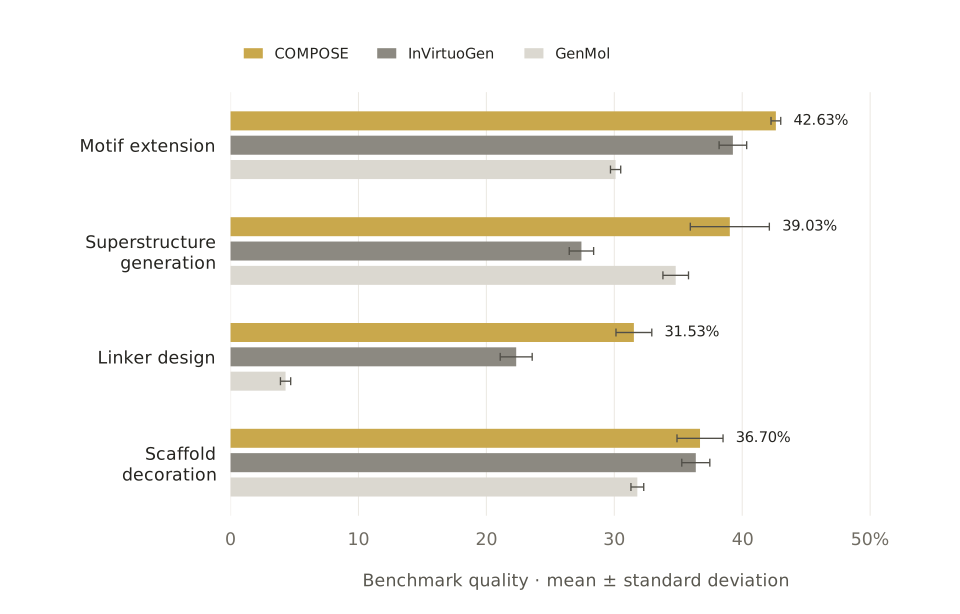
The fragment benchmark tests motif extension, superstructure generation, linker design, scaffold morphing, and scaffold decoration. Each task starts with retained structure and attachment or connectivity requirements. COMPOSE uses ten drug-derived prompts, three generation seeds, and 100 attempted outputs per prompt and seed.
The reported metrics separate chemical validity, uniqueness, diversity, and benchmark quality. Quality is the benchmark’s uniqueness-adjusted computational metric, not a measurement of biological activity. Empty outputs remain in the attempted-output denominator, and prompt fidelity is checked separately from validity.
View quality, uniqueness, diversity, and validity
| Task | Metric | COMPOSE | InVirtuoGen | GenMol |
|---|---|---|---|---|
| Motif extension | Quality (%) | 42.630 ± 0.380 | 39.270 ± 1.078 | 30.100 ± 0.400 |
| Uniqueness (%) | 93.630 ± 0.600 | 96.830 ± 0.290 | 77.500 ± 0.100 | |
| Diversity | 0.664 ± 0.001 | 0.620 ± 0.005 | 0.617 ± 0.002 | |
| Validity (%) | 100.000 ± 0.000 | 68.970 ± 0.759 | 82.900 ± 0.100 | |
| Superstructure generation | Quality (%) | 39.030 ± 3.090 | 27.430 ± 0.953 | 34.800 ± 1.000 |
| Uniqueness (%) | 97.330 ± 0.610 | 99.410 ± 0.157 | 83.600 ± 1.000 | |
| Diversity | 0.725 ± 0.001 | 0.730 ± 0.001 | 0.599 ± 0.009 | |
| Validity (%) | 100.000 ± 0.000 | 75.700 ± 0.898 | 97.500 ± 0.900 | |
| Linker design | Quality (%) | 31.530 ± 1.400 | 22.330 ± 1.250 | 4.300 ± 0.400 |
| Uniqueness (%) | 81.030 ± 0.350 | 84.760 ± 1.620 | 93.900 | |
| Diversity | 0.564 ± 0.002 | 0.520 ± 0.004 | 0.529 ± 0.002 | |
| Validity (%) | 100.000 ± 0.000 | 60.370 ± 0.573 | 16.700 ± 0.200 | |
| Scaffold morphing | Quality (%) | 31.530 ± 1.400 | 22.330 ± 1.250 | 4.300 ± 0.400 |
| Uniqueness (%) | 81.030 ± 0.350 | 84.760 ± 1.620 | 93.900 | |
| Diversity | 0.564 ± 0.002 | 0.520 ± 0.004 | 0.529 ± 0.002 | |
| Validity (%) | 100.000 ± 0.000 | 60.370 ± 0.573 | 16.700 ± 0.200 | |
| Scaffold decoration | Quality (%) | 36.700 ± 1.800 | 36.370 ± 1.096 | 31.800 ± 0.500 |
| Uniqueness (%) | 93.670 ± 0.830 | 88.580 ± 1.130 | 82.700 ± 1.800 | |
| Diversity | 0.563 ± 0.002 | 0.560 ± 0.003 | 0.591 ± 0.001 | |
| Validity (%) | 100.000 ± 0.000 | 90.700 ± 0.616 | 96.600 ± 0.800 |
GenMol’s linker and scaffold-morphing uniqueness is reported without an SD. Scaffold morphing is not an independent experiment. Values follow the manuscript’s headline table; the separate locked-panel audit reports 99.97% motif validity rather than 100.00%.
COMPOSE has the highest reported mean quality in all five table entries, with scaffold morphing reusing the linker outputs. The headline table reports 100% chemical validity throughout. The comparisons also show tradeoffs: InVirtuoGen has higher uniqueness in motif extension, superstructure generation, and linker design; GenMol has higher diversity in scaffold decoration.
The scaffold-decoration quality means are close—36.70 ± 1.80 for COMPOSE and 36.37 ± 1.096 for InVirtuoGen. The table establishes the ordering of reported means, not a statistically resolved improvement for every task.
Improve a property while preserving source similarity
The ZINC-250k editing task starts from molecules with QED between 0.7 and 0.8. A returned candidate succeeds if it reaches QED ≥ 0.9 while retaining radius-two Morgan-fingerprint Tanimoto similarity ≥ 0.4 to its source. QED is a calculated drug-likeness descriptor; it is not potency, safety, or therapeutic efficacy.
COMPOSE returns eight terminal controlled trajectories per source. It solves 446 of the 800 sources: 55.8%, with a 95% Wilson interval of 52.3–59.2%. Two sources that did not return completed results are counted as failures. Intermediate molecules are not pooled as extra candidates, and unsuccessful slots are not replaced by fresh samples.
| Method | Candidates / source | Reported success |
|---|---|---|
| COMPOSE | 8 | 55.8% |
| GrIDDD | 20 | 45.1% |
| MMPA | 20 | 32.9% |
| VSeq2Seq | 20 | 58.5% |
| VJTNN | 20 | 59.9% |
| VJTNN+GAN | 20 | 60.6% |
| AtomG2G | 20 | 73.6% |
| HierG2G | 20 | 76.9% |
The paper’s GrIDDD comparison is useful context, but its sources are different and it allows 20 candidates per source. Published translation methods also report higher success rates, including 76.9% for HierG2G with 20 candidates and different training information. COMPOSE’s result demonstrates transfer of the frozen molecular reference to the constrained editing task; it does not establish the best success rate across the published record.
Diversity also depends on the averaging rule. Among the 335 successful COMPOSE sources with at least two distinct successful candidates, mean diversity is 0.4999. Including the 111 successful sources with only one distinct candidate lowers it to 0.376. These conditional quantities should not be treated as diversity over all 800 sources.
Optimize 22 objectives under a fixed query budget
Practical Molecular Optimization asks the controller to improve a black-box objective using scores observed during search. The paper follows the PMO-1K comparison across 22 objectives, including rediscovery, similarity, isomer, multi-property, and predicted-activity tasks. Each objective begins from the same task-independent initialization bank, with no target-oracle prescreening outside the budget.
The main metric is the mean score of the ten best molecules after 1,000 oracle evaluations. COMPOSE reaches a mean final Top-10 of 0.563, compared with 0.542 for GenMol, 0.532 for InVirtuoGen, 0.531 for REINVENT, and 0.530 for Graph-GA. It leads on 11 of the 22 individual objectives. Per-objective results are means and standard deviations over three seeds.
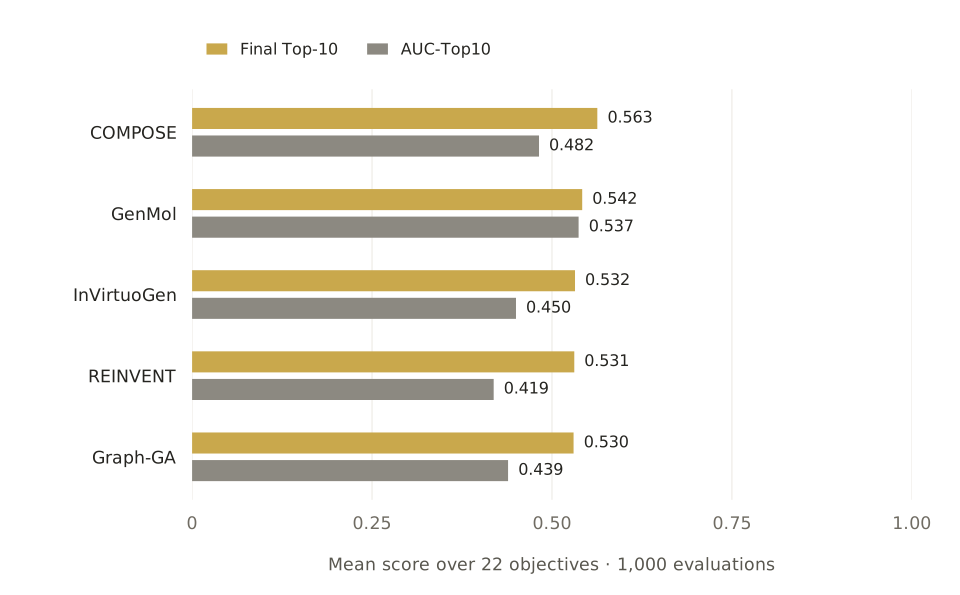
| Method | Final Top-10 ↑ | AUC-Top10 ↑ |
|---|---|---|
| COMPOSE | 0.563 | 0.482 |
| GenMol | 0.542 | 0.537 |
| InVirtuoGen | 0.532 | 0.450 |
| REINVENT | 0.531 | 0.419 |
| Graph-GA | 0.530 | 0.439 |
View all 22 objectives and baseline comparisons
| Objective | COMPOSE | GenMol | InVirtuoGen | REINVENT | Graph-GA |
|---|---|---|---|---|---|
| Albuterol similarity | 0.782 ± 0.020 | 0.567 ± 0.010 | 0.566 ± 0.010 | 0.583 ± 0.030 | 0.508 ± 0.060 |
| Amlodipine MPO | 0.539 ± 0.035 | 0.571 ± 0.010 | 0.536 ± 0.010 | 0.496 ± 0.010 | 0.539 ± 0.010 |
| Celecoxib rediscovery | 0.335 ± 0.053 | 0.456 ± 0.010 | 0.413 ± 0.030 | 0.426 ± 0.030 | 0.385 ± 0.010 |
| Deco hop | 0.586 ± 0.010 | 0.641 ± 0.030 | 0.612 ± 0.000 | 0.591 ± 0.010 | 0.607 ± 0.010 |
| DRD2 | 0.979 ± 0.018 | 0.984 ± 0.000 | 0.993 ± 0.010 | 0.975 ± 0.010 | 0.999 ± 0.010 |
| Fexofenadine MPO | 0.751 ± 0.043 | 0.731 ± 0.010 | 0.702 ± 0.020 | 0.695 ± 0.010 | 0.699 ± 0.000 |
| GSK3B | 0.535 ± 0.065 | 0.673 ± 0.010 | 0.572 ± 0.090 | 0.773 ± 0.080 | 0.590 ± 0.030 |
| Isomers C7H8N2O2 | 0.911 ± 0.029 | 0.485 ± 0.050 | 0.597 ± 0.050 | 0.879 ± 0.040 | 0.846 ± 0.020 |
| Isomers C9H10N2O2PF2Cl | 0.895 ± 0.064 | 0.553 ± 0.040 | 0.672 ± 0.100 | 0.696 ± 0.050 | 0.723 ± 0.040 |
| JNK3 | 0.245 ± 0.041 | 0.492 ± 0.010 | 0.484 ± 0.080 | 0.205 ± 0.020 | 0.244 ± 0.030 |
| Median1 | 0.294 ± 0.029 | 0.236 ± 0.000 | 0.243 ± 0.010 | 0.236 ± 0.020 | 0.222 ± 0.010 |
| Median2 | 0.181 ± 0.012 | 0.244 ± 0.000 | 0.187 ± 0.020 | 0.194 ± 0.000 | 0.211 ± 0.010 |
| Mestranol similarity | 0.503 ± 0.013 | 0.438 ± 0.010 | 0.408 ± 0.020 | 0.354 ± 0.040 | 0.399 ± 0.030 |
| Osimertinib MPO | 0.833 ± 0.027 | 0.815 ± 0.000 | 0.783 ± 0.000 | 0.776 ± 0.010 | 0.793 ± 0.000 |
| Perindopril MPO | 0.525 ± 0.018 | 0.517 ± 0.010 | 0.454 ± 0.010 | 0.417 ± 0.010 | 0.471 ± 0.010 |
| QED | 0.945 ± 0.002 | 0.931 ± 0.010 | 0.936 ± 0.000 | 0.940 ± 0.000 | 0.939 ± 0.000 |
| Ranolazine MPO | 0.770 ± 0.052 | 0.686 ± 0.010 | 0.687 ± 0.020 | 0.639 ± 0.010 | 0.646 ± 0.020 |
| Scaffold hop | 0.461 ± 0.007 | 0.506 ± 0.000 | 0.486 ± 0.010 | 0.467 ± 0.000 | 0.473 ± 0.010 |
| Sitagliptin MPO | 0.343 ± 0.009 | 0.228 ± 0.020 | 0.338 ± 0.040 | 0.310 ± 0.000 | 0.332 ± 0.020 |
| Thiothixene rediscovery | 0.280 ± 0.038 | 0.397 ± 0.010 | 0.342 ± 0.020 | 0.326 ± 0.020 | 0.323 ± 0.010 |
| Troglitazone rediscovery | 0.314 ± 0.057 | 0.317 ± 0.010 | 0.266 ± 0.010 | 0.260 ± 0.000 | 0.287 ± 0.010 |
| Zaleplon MPO | 0.385 ± 0.066 | 0.460 ± 0.010 | 0.436 ± 0.000 | 0.448 ± 0.000 | 0.432 ± 0.010 |
These are the manuscript’s PMO-1K results, not scores from a 10,000-call benchmark. Individual objectives remain computational proxies.
The second metric, AUC-Top10, measures performance across the search budget rather than only at its endpoint. Here COMPOSE’s mean is 0.482, below GenMol’s 0.537. The combination supports a stronger final result in this comparison, while showing that GenMol accumulates a higher average score across the allotted search.
Task-level outcomes remain uneven. COMPOSE is strong on albuterol similarity and the two isomer objectives, but trails the strongest reported methods on GSK3B, JNK3, and several rediscovery tasks. These are results for the 1,000-call setting; they are not interchangeable with published 10,000-call PMO scores.
Optimize a lead within a constrained molecular region
The protein-specific benchmark covers PARP1, factor VII, 5-HT1B, BRAF, and JAK2, with three starting leads per target. Two source-similarity thresholds, δ = 0.4 and δ = 0.6, create 30 target–lead–threshold cases. Evaluated endpoints must also satisfy QED ≥ 0.6 and synthetic-accessibility score ≤ 4.
A molecular target, at two scales
Structure study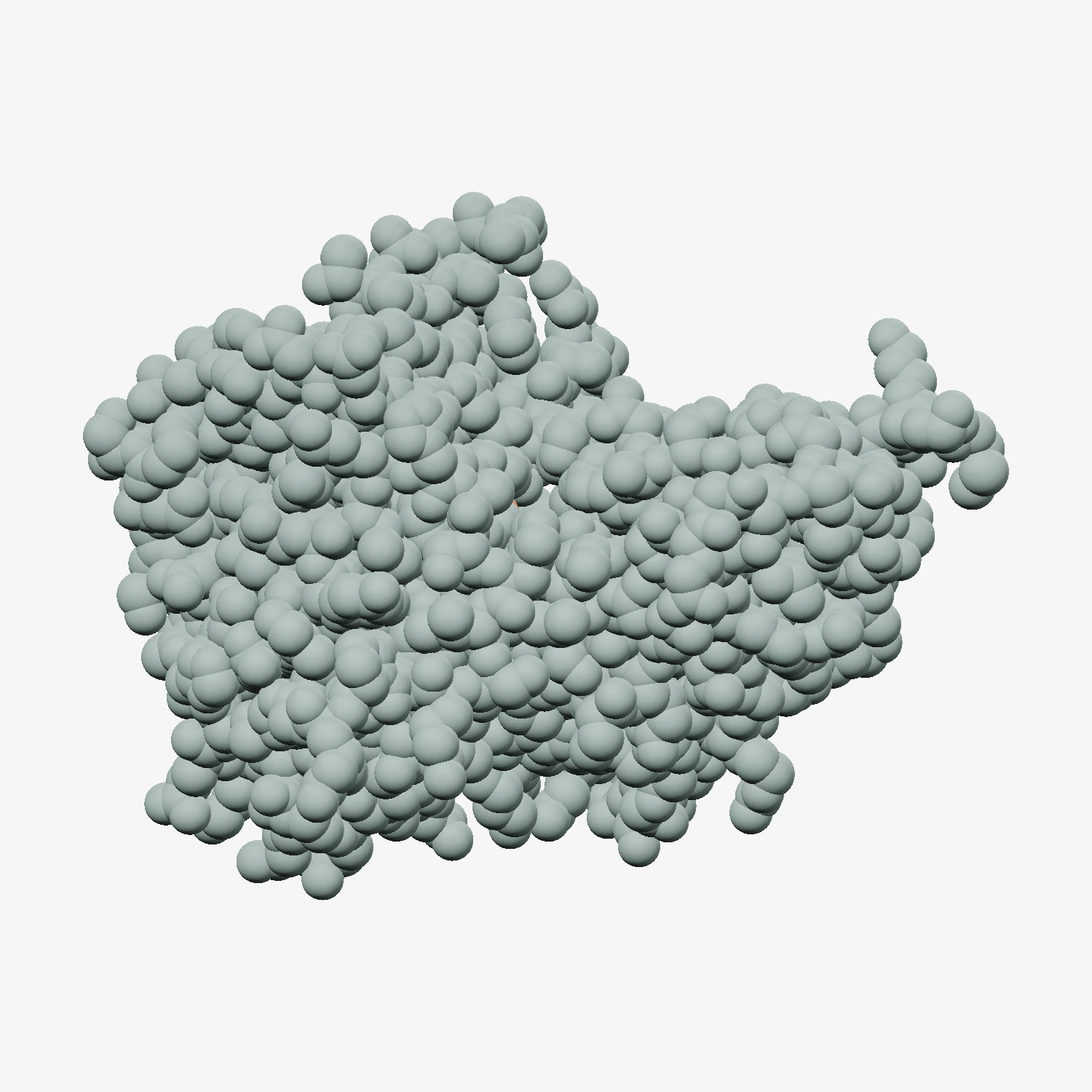
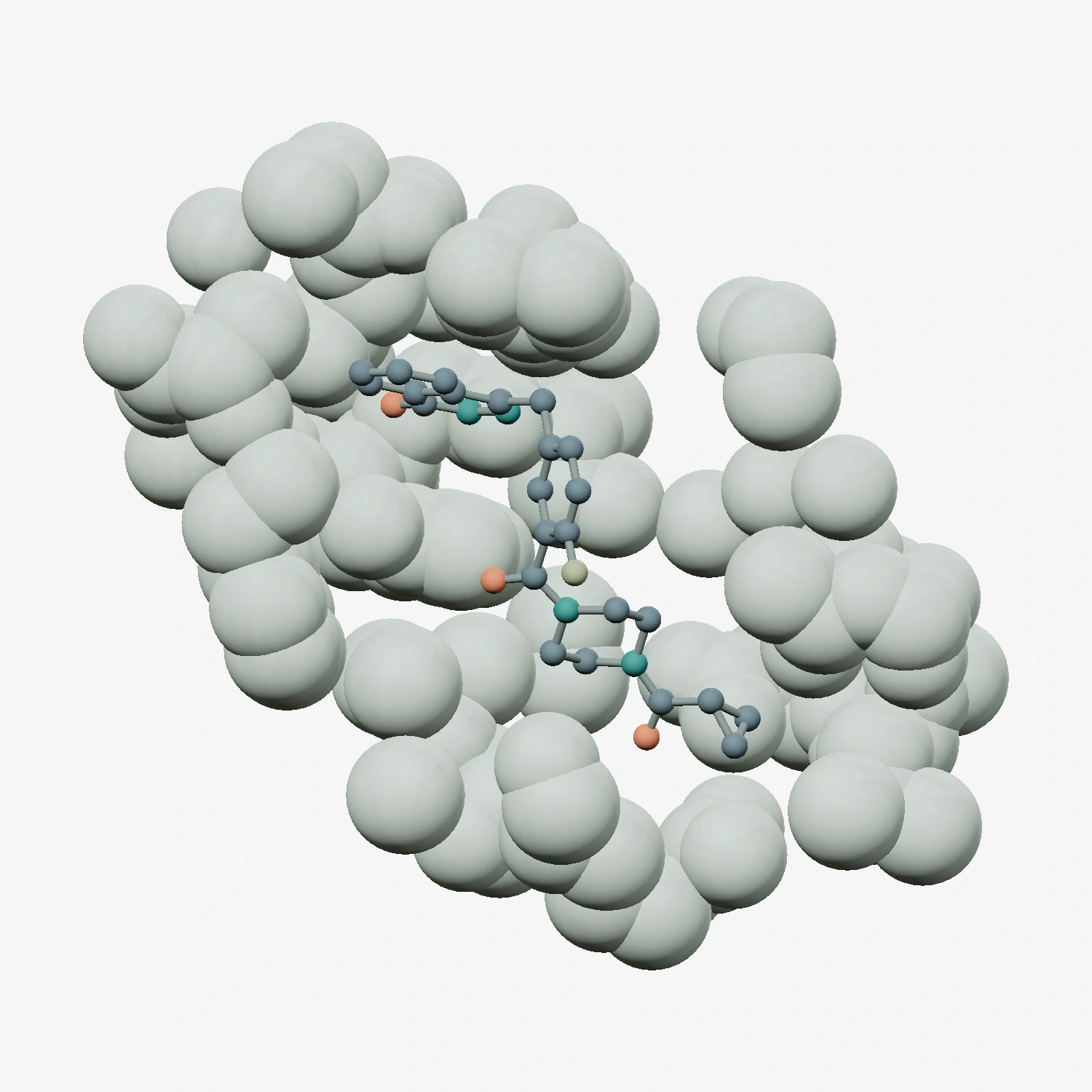
An experimental PARP1–olaparib complex, shown as structural context for one of COMPOSE’s lead-optimization targets. The close-up exposes the bound ligand by omitting foreground protein atoms. This illustration uses an independent structure; the benchmark results appear below.
PDB 7AAD · PARP1 with olaparib ↗Molecular structure
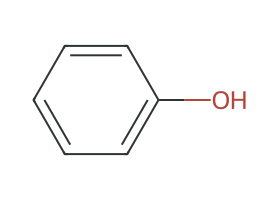
PARP1 starting lead
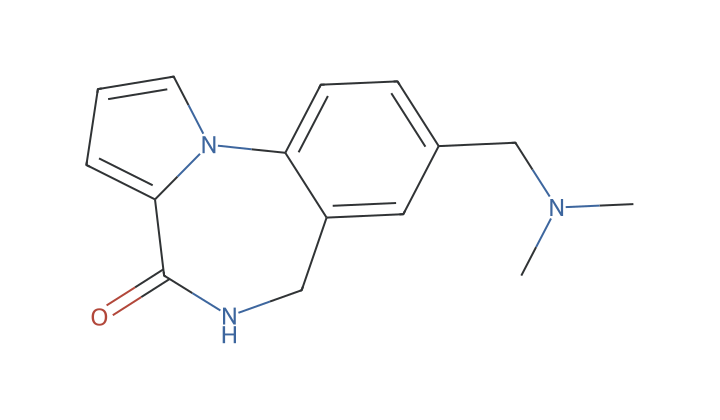 2D molecular drawing
COMPOSE spends 250 docking evaluations per case, compared with 1,000 in the published InVirtuoGen and GenMol comparisons. It obtains the lowest reported feasible QuickVina2 score in 10 of 15 cases at δ = 0.4 and 13 of 15 at δ = 0.6—23 of 30 cases overall.
| Similarity threshold | COMPOSE leads | COMPOSE calls / case | Baseline calls / case |
|---|---|---|---|
| δ = 0.4 | 10 / 15 cases | 250 | 1,000 |
| δ = 0.6 | 13 / 15 cases | 250 | 1,000 |
View all 30 docking cases
| Target / lead | Starting score | COMPOSE | InVirtuoGen | GenMol |
|---|---|---|---|---|
| PARP1 · 1 | -7.3 | -11.9 | -14.1 | -10.6 |
| PARP1 · 2 | -7.8 | -12.3 | -13.4 | -11.0 |
| PARP1 · 3 | -8.2 | -14.1 | -9.0 | -11.3 |
| FA7 · 1 | -6.4 | -9.3 | -8.4 | -8.4 |
| FA7 · 2 | -6.7 | -9.4 | -8.9 | -8.4 |
| FA7 · 3 | -8.5 | -9.6 | -8.0 | — |
| 5HT1B · 1 | -4.5 | -12.4 | -13.3 | -12.9 |
| 5HT1B · 2 | -7.6 | -11.9 | -12.0 | -12.3 |
| 5HT1B · 3 | -9.8 | -12.5 | -10.9 | -11.6 |
| BRAF · 1 | -9.3 | -12.2 | -10.1 | -10.8 |
| BRAF · 2 | -9.4 | -10.5 | -10.8 | -10.8 |
| BRAF · 3 | -9.8 | -10.9 | -10.6 | -10.6 |
| JAK2 · 1 | -7.7 | -10.4 | -10.2 | -10.2 |
| JAK2 · 2 | -8.0 | -11.3 | -10.5 | -10.0 |
| JAK2 · 3 | -8.6 | -10.7 | -10.2 | -9.8 |
| Target / lead | Starting score | COMPOSE | InVirtuoGen | GenMol |
|---|---|---|---|---|
| PARP1 · 1 | -7.3 | -13.6 | -12.3 | -10.4 |
| PARP1 · 2 | -7.8 | -12.7 | -11.7 | -9.7 |
| PARP1 · 3 | -8.2 | -11.3 | -10.7 | -9.2 |
| FA7 · 1 | -6.4 | -6.4 | -7.7 | -7.3 |
| FA7 · 2 | -6.7 | -7.8 | -7.5 | -7.6 |
| FA7 · 3 | -8.5 | -8.5 | -7.4 | — |
| 5HT1B · 1 | -4.5 | -13.3 | -12.4 | -12.1 |
| 5HT1B · 2 | -7.6 | -12.2 | -12.0 | -12.0 |
| 5HT1B · 3 | -9.8 | -10.8 | -10.6 | -10.5 |
| BRAF · 1 | -9.3 | -9.0 | -9.7 | — |
| BRAF · 2 | -9.4 | -11.0 | -10.4 | -9.7 |
| BRAF · 3 | -9.8 | -11.5 | -10.3 | -10.5 |
| JAK2 · 1 | -7.7 | -10.6 | -9.7 | -9.3 |
| JAK2 · 2 | -8.0 | -10.8 | -10.4 | -9.4 |
| JAK2 · 3 | -8.6 | -10.8 | -10.3 | — |
Lead numbers follow the row order within each target in the manuscript. A dash means no feasible baseline result was reported; it is not assigned a score. COMPOSE and InVirtuoGen report scores in all 30 cells; GenMol reports 26.
The query budget is one quarter of the baseline allowance, but this is not a fourfold wall-time claim. Proposal construction and inexpensive property checks are separate from docking calls. Baseline values are transcribed from published tables rather than recomputed through COMPOSE’s docking pipeline.
Repeat docking of the same molecule has a reported median variation of 0.70 kcal/mol in the COMPOSE pipeline. Small differences between individual cells should therefore not be interpreted as resolved improvements. Docking scores rank computational candidates under a scoring protocol; binding and biological function still require experiments.
Which parts of the method contribute?
Learned preferences beyond valid moves
In superstructure generation, replacing learned edit-family and mark probabilities with uniform choices lowers mean quality from 39.03% to 25.40% and uniqueness from 97.33% to 90.17%. Both arms retain 100% validity and prompt compliance. The executor alone does not explain the quality difference.
The mean quality gain is 13.63 percentage points, with a 95% prompt-bootstrap interval of 4.27–23.07 points. The learned law improves six prompts, trails on two, and ties on two. The learned stopping mechanism remains active in both arms, so this comparison isolates edit-selection probabilities rather than every learned component.
Selection on the same candidate proposals
A separate comparison holds the proposed endpoints, structural checks, and evaluator fixed, then changes only selection on saved fragment-program panels.
| Task | Deployed selection | Uniform selection | Difference |
|---|---|---|---|
| Motif extension | 42.63 | 37.20 | +5.43 pp |
| Scaffold decoration | 36.70 | 34.47 | +2.23 pp |
| Linker design | 31.53 | 24.00 | +7.53 pp |
Reference-based selection improves mean quality for motif extension and scaffold decoration. For linker design, the deployed selector combines reference scores with a fourfold preference for previously unseen endpoints, so its gain cannot be assigned to reference weighting alone. Uniform selection retains slightly higher motif and linker diversity.
Coordinated programs versus legal edit chains
The PMO ablation replaces structured programs with uniform legal edit chains under a matched planned primitive-edit allowance. The executor, endpoint eligibility, initialization, and query-allocation rules stay fixed. Fourteen of the 18 planned objective-seed comparisons completed.
| Proposal mechanism | Final Top-10 ↑ | AUC-Top10 ↑ |
|---|---|---|
| Structured programs | 0.621 | 0.503 |
| Uniform legal edit chains | 0.558 | 0.465 |
Structured programs have the higher value in 10 of the 14 completed pairs for each metric. Uniform chains have higher mean scores on the C9 isomer objective and scaffold hopping. Objectives with more completed replicates receive greater weight in this aggregate, and one excluded run failed for an arm-dependent reason. The result supports the structured proposer on the completed panel, without isolating every ingredient of program construction.
Future-aware decisions on reachable targets
On a separate panel of 65 held-out source–target pairs with known executable solution paths, greedy local decisions recover 26 targets. All-candidate lookahead recovers 40. Prioritizing one successor with the learned future-value head also recovers 40 while evaluating 34.6% of the continuations used by exhaustive lookahead.
The two methods do not recover exactly the same 40 targets. The planner also keeps the greedy action unless lookahead finds an improvement, so the comparison is one-sided by construction. This study measures target recovery and continuation work on a defined reachable panel; it is separate from the 800-source QED benchmark.
From computational control to useful molecules
The experiments support a specific conclusion: one frozen molecular reference can be used across several generation and optimization tasks when paired with appropriate controllers. The performance comes from the complete system—representation, learned preferences, program construction, selection, and objective feedback.
Its boundaries are equally specific. The executor limits which molecular states and changes are representable. The current graph representation does not encode stereochemistry. Synthetic transition supervision does not establish observed chemical reaction preferences, and validity does not establish synthetic accessibility.
Objective quality is another limit. The manuscript reports that the GSK3B predictor was exploitable in every tested arm, with high-scoring candidates having poor QED and synthetic-accessibility scores. Those oracle values remain in the declared benchmark reduction, but they are not evidence of biological activity or candidate quality.
Together, FORGE and COMPOSE address complementary design decisions: generating complete molecular structures with reaction-assembly checks, and exploring molecular changes under explicit constraints and objectives. Synthesis, screening, and biological evaluation are the next steps needed to connect those computational designs to function.